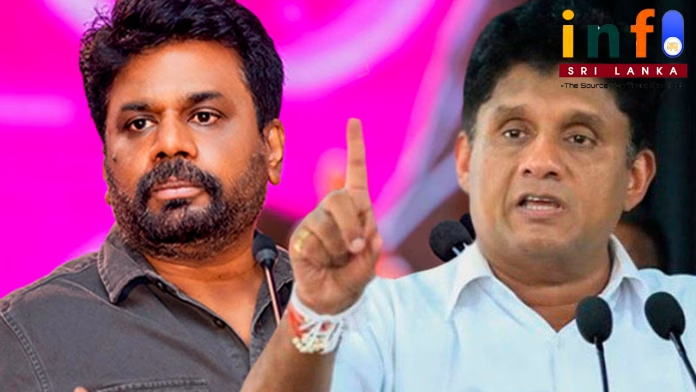
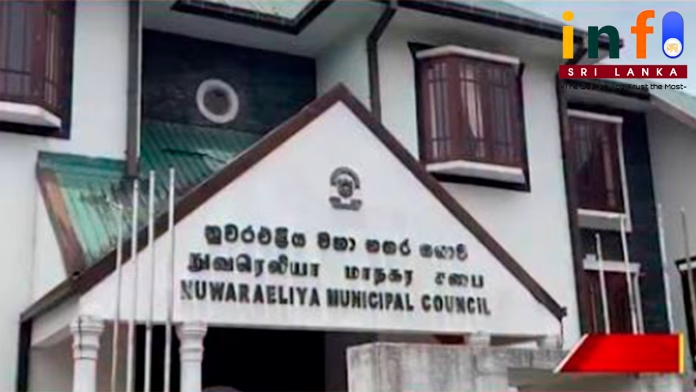
In a significant development regarding the establishment of power in local government institutions, the Samagi Jana Balawegaya (SJB) and the United National Party (UNP) reached a special agreement today. This consensus was reached during a discussion between Opposition Leader Sajith Premadasa and key UNP officials.
Representing the UNP at the meeting were Party Chairman Vajira Abeywardena, General Secretary Thalatha Athukorala, and Sagala Ratnayake. Following the discussion, a joint media release signed by the general secretaries of both parties was issued.
Meanwhile, President Anura Dissanayake is scheduled to hold a special discussion today with members of five independent groups who contested and won seats in the Colombo Municipal Council during the recent local government elections. This discussion aims to secure their support for the National People’s Power (NPP) in establishing power in the Colombo Municipal Council.
A total of nine members from five independent groups were elected to the Colombo Municipal Council in the local government elections.
Vietnam has risen from the ashes of war to become one of Asia’s most dynamic and resilient economies. Meanwhile, Sri Lanka, despite similar beginnings, continues to face economic stagnation, fiscal distress, and developmental setbacks. The contrasting outcomes of these two nations—both of which experienced protracted conflicts, colonial rule, and periods of political turbulence—offer vital insights into the ingredients of sustainable post-conflict recovery and long-term economic success.
Over the past few decades, Vietnam has undergone a stunning transformation, rising from one of the poorest nations in Southeast Asia to a dynamic global economic force. This remarkable shift is not merely a tale of resilience but a testament to the country’s strategic policy choices, market-oriented reforms, and its ability to navigate and adapt to global economic trends. Today, Vietnam stands as a shining example of economic success, garnering the attention of governments, investors, and economists worldwide.
Vietnam has an estimated population of about 100 million in 2024, making it one of Southeast Asia’s most populous countries. It has a young and diverse population, with the Kinh ethnic group making up the majority. Population density is especially high in urban centers like Ho Chi Minh City and Hanoi, contributing to a dynamic workforce. The country spans 331,210 square kilometers and features diverse geography, including mountains, forests, and a long coastline along the South China Sea, which supports its agricultural success and natural resource development.
Sri Lanka, on the other hand, has a much smaller population of 22 million in 2024. Its population is ethnically diverse. The country has an aging population, with an increasing number of elderly citizens. Its land area is 65,610 square kilometers, and it is known for its rich biodiversity, including tropical rainforests, beaches, and mountains. Sri Lanka’s strategic location in the Indian Ocean has significantly influenced its history and economy.
Asia’s 15 largest economies
Vietnam has been ranked 12th among Asia’s 15 largest economies by Seasia Stats, with a projected GDP of 506 billion USD in 2025. The ranking highlights Vietnam’s rapid growth, largely fueled by booming manufacturing and foreign investment. With an expected 7% GDP growth in 2024, Vietnam stands out as one of the fastest-growing economies globally. While China, Japan, and India remain Asia’s top three economies, Vietnam’s rise places it just behind Thailand and the Philippines, and ahead of several other regional players. Indonesia leads Southeast Asia with a projected GDP of 1.5 trillion USD, followed by Singapore, Thailand, and the Philippines.
In contrast, Sri Lanka ended its 26-year civil war in 2009. While the end of conflict created expectations of a rapid economic revival, the post-war years were marked by inconsistent policy, rising debt, and missed opportunities for structural reform.
Reform to Resilience
Vietnam’s economic progress is nothing short of extraordinary. In 1986, real GDP per capita stood at under US$700, by 2023, it had climbed to nearly US$4,500 (constant USD). The country has consistently maintained GDP growth rates between 6% and 7% for much of the last two decades, with projections of 6.5% growth in 2025.
Key drivers of Vietnam’s success include:
Market-Oriented Reforms: Đổi Mới ushered in a shift from a centrally planned economy to one open to private enterprise and foreign investment.
Export-Led Growth: Vietnam became a global manufacturing hub, exporting textiles, electronics, and agricultural products.
Foreign Direct Investment (FDI): Investor-friendly policies attracted multinational corporations like Samsung, Intel, and Nike.
Education and Human Capital: Vietnam prioritized universal primary education, with high secondary enrollment and a skilled, youthful workforce.
Stable Policy Environment: Consistent economic policies and long-term planning reassured investors and partners.
Vietnam also demonstrated resilience during global crises. Despite the COVID-19 pandemic and disruptions in global trade, its economy bounced back swiftly, supported by a diversified industrial base and prudent macroeconomic management.
Sri Lanka
Inconsistent Economic Policy: Shifts between socialist and market-oriented approaches have created uncertainty, deterring long-term investment.
Over-Reliance on Imports and Debt: A failure to develop an export-driven economy left Sri Lanka vulnerable to trade imbalances. Heavy reliance on foreign debt led to a sovereign default in 2022.
Weak FDI Performance: In 2023, Sri Lanka attracted just over US$1 billion in FDI—compared to Vietnam’s US$36 billion—largely due to governance issues and infrastructure deficits.
Underdeveloped Industrial Sector: Despite the presence of Board of Investment (BOI) zones, industrial growth has been constrained by bureaucracy, poor logistics, and underinvestment.
Macroeconomic Crisis: In 2022, Sri Lanka experienced its worst economic crisis in decades, with inflation exceeding 70%, fuel and food shortages, and a complete collapse of foreign reserves.
While Vietnam built strong buffers and diversified its economy, Sri Lanka remained overly dependent on volatile sectors like tourism and remittances, both of which collapsed during the pandemic.
1. Policy Stability and Vision
Vietnam’s consistent, long-term economic strategy—grounded in market liberalization—was key to investor confidence. Sri Lanka must establish a coherent economic vision that transcends political cycles.
2. Export and Industrial Policy
Vietnam transformed into a manufacturing powerhouse. Sri Lanka must shift from consumption-led growth to export-oriented development, particularly in high-value sectors.
3. Human Capital and Skills
Vietnam aligned education with industry demand. Sri Lanka needs to modernize its education system, emphasizing vocational training, STEM, and digital skills.
4. Governance and Decentralization
Vietnam empowered local governments to implement policies and attract investment. Sri Lanka could benefit from devolving economic decision-making to the provincial level.
5. Debt Discipline and Fiscal Reform
Vietnam avoided debt distress through disciplined fiscal management. Sri Lanka must commit to responsible borrowing, tax reform, and reducing wasteful expenditure.
Comparative Snapshot (2024)
Indicator
Vietnam
Sri Lanka
Population
~100 million
~22 million
GDP (Projected, 2025)
US$506 billion
~US$85 billion
GDP Growth (2024)
6.5%
~2–3%
FDI Inflows (2023)
US$36 billion
~US$1 billion
External Reserves
US$95 billion
~US$4–5 billion
IMF Program
None
Ongoing (since 2023)
Primary Export Sectors
Electronics, garments
Tea, textiles, tourism
Debt-to-GDP Ratio
~40%
Over 100% (pre-default)
Conclusion
Vietnam and Sri Lanka exemplify how different policy paths can shape national outcomes. Vietnam’s success story is built on pragmatism, stability, and openness to global markets. Sri Lanka’s setbacks stem from internal divisions, erratic policy, and fiscal indiscipline.
Yet, Sri Lanka’s future is not predetermined. With the right reforms—rooted in transparency, innovation, and economic inclusiveness—the country can regain lost momentum. Vietnam’s journey offers a powerful blueprint, but ultimately, Sri Lanka must chart its own course with clarity, courage, and commitment.
Writer
Visvalingam Muralithas is a researcher in the legislative sector, specializing in policy analysis and economic research. He is currently pursuing a PhD in Economics at the University of Colombo, with a research focus on governance, development, and sustainable growth.
He holds a Bachelor of Arts in Economics (Honours) from the University of Jaffna and a Master’s degree in Economics from the University of Colombo. His academic background is further strengthened by postgraduate diplomas in Education from the Open University of Sri Lanka and in Monitoring and Evaluation from the University of Sri Jayewardenepura.
In addition to his research work, Muralithas has contributed to academia by teaching economics at the University of Colombo and the Institute of Bankers of Sri Lanka (IBSL) and has also gained industry experience as an investment advisor at a stock brokerage firm affiliated with the Colombo Stock Exchange.
The Sri Lanka Podujana Peramuna (SLPP) General Secretary Sagara Kariyawasam stated that political parties have a responsibility and duty to stand for the public opinion expressed in the recent local government elections. He mentioned that discussions are underway on how to fulfill the aspirations of the people without compromising the policies of the respective parties.
Speaking at a press conference today (18th), he emphasized that the public has delivered a clear message in the local polls, and political parties are obligated to represent that sentiment.
Kariyawasam further noted that discussions are being held with all political parties, including the Samagi Jana Balawegaya (SJB), to explore ways to meet the people’s aspirations while safeguarding party principles.
Meanwhile, SJB parliamentarian Dayasiri Jayasekara commented that the public voted for independent groups because they contested against the Janatha Vimukthi Peramuna (JVP). Therefore, he argued that independent groups have no right to support the JVP anywhere.
President Anura Kumara Dissanayake, who was initially reported as not attending the 16th commemoration of the victory over separatist LTTE terrorism this morning (18th), confirmed his participation shortly ago.
Concerns arose after the Chairman of the Ranaviru Seva Authority, retired Brigadier Senarath Kohene, informed the media that the Deputy Minister of Defence would be representing the President at the ceremony held near the War Heroes’ Memorial at Battaramulla Parliamentary Grounds. This sparked inquiries on social media and among retired war veterans as to whether the President or the Prime Minister were refusing to commemorate the war heroes. While it is customary for the Prime Minister to attend in the President’s absence, the government’s decision to send a Deputy Minister surprised many.
Some critics charged that commemorating war heroes was being relegated to the Deputy Minister level, contrary to Sri Lanka’s diplomatic protocol where the President, Prime Minister, Speaker, Leader of the Opposition, Cabinet Ministers, and other high-ranking officials typically participate.
However, retired Brigadier Senarath Kohene, Chairman of the Ranaviru Seva Authority, stated on national television that the war heroes’ commemoration will proceed under the patronage of President Anura Kumara Dissanayake.
Attorney General Parinda Ranasinghe has appointed a four-person committee to study the report of the Batalanda Commission.
The committee will be headed by Senior Additional Solicitor General Rohantha Abeysooriya. Deputy Solicitor General Dileepa Peiris, Senior State Counsel Jayani Wegodapola, and State Counsel Shakthi Jagodaarachchi will serve as the other members.
The committee is tasked with determining whether charges can be filed based on the evidence in the Batalanda Commission report and identifying offenses that have exceeded the statute of limitations. The committee will also identify any matters that require further investigation.
The Batalanda Commission report was recently forwarded to the Attorney General by the President’s Office, following the President’s instructions. The Presidential Media Division states that the government has decided to take further action regarding the report.
Discussions surrounding the Batalanda Commission report, which investigated events during the 1988-1990 period, resurfaced after former President Ranil Wickremesinghe raised certain points on Al Jazeera’s Head to Head program on March 6th.
Colombo is set to witness the captivating beauty of Kathak, a classical Indian dance form renowned for its intricate footwork, graceful movements, and expressive storytelling, at the upcoming “Kathak Vilas” performance.
Presented by the Rangara Kathak Dance Academy, “Kathak Vilas” will occur on Monday, May 26th, at 6:00 PM at the Swami Vivekananda Cultural Centre (SVCC) auditorium in Colombo.
This enchanting evening is orchestrated under Shastrapati Thilini Rangika Dissanayake’s guidance; admission is free for all to experience this cultural treat
The Presidential Secretariat has been issued a notice to appear before the Information Commission on May 28, 2025, for failing to provide requested information under the Right to Information (RTI) Act within the stipulated timeframe.
The summons follows an appeal lodged due to the Secretariat’s lack of response to a request seeking details about President Anura Kumara Dissanayake’s personal staff, including their salaries, allowances, and vehicles, all funded by public money.
The initial RTI application was submitted to the Presidential Secretariat on January 29, 2025. However, the applicant escalated the matter after more than two months without a proper response.
The requested information includes the number of individuals recruited or assigned to the 9th Executive President’s staff, their designations, the monthly expenditure on their salaries and allowances, the number and types of vehicles allocated to them, and who is authorized to use these vehicles.
Additionally, the request seeks details about the ministries assigned to officials appointed for the presidential term only, along with the vehicle numbers and types provided to each institution and ministry since September 23, 2024.
According to the Right to Information Act No. 12 of 2016, public authorities must acknowledge receipt of an information request. The Presidential Secretariat did acknowledge receipt on January 30, 2025. However, the Act mandates the provision of information within 14 working days, or notification of the reasons for any delay. The failure to adhere to these statutory requirements led to the appeal against the designated officer of the Presidential Secretariat.
Notably, information regarding the personal staff of previous presidents has been obtained and published under the RTI Act, suggesting no legal impediment to the disclosure of the currently requested details by the Presidential Secretariat.
COLOMBO, SRI LANKA - NOVEMBER 10: Ousted United National Party (UNP) Prime Minister Ranil Wickremesinghe speaks from his office November 10, 2018 in Colombo, Sri Lanka. The political crisis started last month when United National Party (UNP) Prime Minister Ranil Wickremesinghe was suddenly replaced with Mahinda Rajapaksa, a controversial former president. Sri Lankan President Maithripala Sirisena dissolved the country's parliament yesterday declaring a snap election on January 5th. (Photo by Paula Bronstein/Getty Images)
In a significant political move, former President and United National Party (UNP) leader Ranil Wickremesinghe has spearheaded an initiative to establish governing bodies in all local authorities where the National People’s Power (NPP) does not hold a majority, including the Colombo Municipal Council.
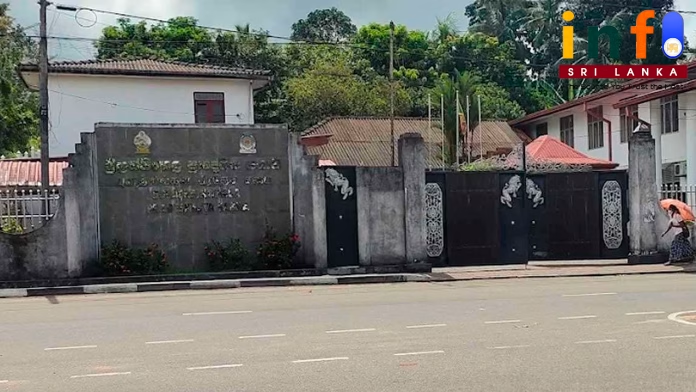
Leaders of opposition political parties reached an agreement during a meeting held today, May 14, at Mr. Wickremesinghe’s political office on Flower Road, Colombo.
To this end, the General Secretaries of the respective parties are scheduled to meet on May 15, 2025, to prepare the nomination lists for the local authorities where power will be established.
The meeting saw the participation of several prominent political figures, including former Speaker Mahinda Yapa Abeywardena; Parliamentarian Nalin Bandara representing the Samagi Jana Balavegaya (SJB); Namal Rajapaksa, the National Organizer of the Sri Lanka Podujana Peramuna (SLPP); Nimal Siripala de Silva and Duminda Dissanayake representing the Sri Lanka Freedom Party (SLFP); Anura Priyadarshana Yapa of the United National Front; Palani Thigambaran, leader of the Workers’ National Front; Mano Ganeshan, leader of the Democratic People’s Front; Udaya Gammanpila, leader of the Pivithuru Hela Urumaya; Jeevan Thondaman, General Secretary of the Lanka Labour Congress; Asanka Navaratne, Sugeeshwara Bandara, and Veera Kumara Dissanayake representing the New Democratic Front; former Members of Parliament Pramitha Bandara Thennakoon, Premnath C. Dolawatta, Nimal Lanza, and Mohamed Muzammil; and representing the UNP, its Chairman Vajira Abeywardena, General Secretary Thalatha Athukorala, National Organizer Sagala Ratnayake, and former Minister Harin Fernando.
Former Speaker Mahinda Yapa Abeywardena has been entrusted with the responsibility of convening these joint meetings of opposition party leaders regarding the acquisition of power in the local authorities.
Reports indicate that a decision was also reached to hold future discussions with all groups opposed to the Janatha Vimukthi Peramuna (JVP)-led NPP and to work together.
According to data released by the Central Bank of Sri Lanka, the amount of money sent to Sri Lanka by expatriate workers in April 2025 reached US$ 646.1 million.
This has pushed the total remittances for the first four months of 2025 to US$ 2,460.5 million, marking a significant 18.3% increase compared to the same period in 2024, when remittances stood at US$ 2,079.9 million.
Following their recent press conference, the newly formed collective, “Dinana Dakuna” (Winning South) – a group advocating for the reinstatement of right-wing politics – has released a statement responding to public and media reactions.
The group, in a strongly worded note, claims that President Anura’s current political and economic strategies are unsustainable and will lead to the nation’s failure by 2028.
“When ‘Dinana Dakuna’ suggested that Anura cannot succeed, a majority of those who voted for the ‘compass’ party appeared agitated and some even became enraged,” the statement read, referring to the NPP’s election symbol. However, the collective insists their criticism is not personal but a warning about the challenges the Sri Lankan state will face under the current trajectory.
The group elaborated on their concerns, citing the “vicious challenges” posed by the debt economy. They argued that if President Anura fails to overcome these challenges, the entire country will suffer, not just those who criticize him.
Addressing accusations leveled against them, “Dinana Dakuna” acknowledged that some perceive its members as former United National Party (UNP) loyalists, “ghosts of the past,” and individuals who benefited from or protected past corruption. They also addressed claims of being rejected by the public and politically bankrupt opportunists.
While admitting that a majority within the collective has connections to the UNP and the Samagi Jana Balawegaya (SJB), they emphasized that their current views on right-wing politics are independent of these parties. They also stated that they are sensitive to criticisms regarding their political predecessors and acknowledged the presence of individuals within their past political affiliations who were responsible for both the progress and detriment of the country.
“We have sincere self-criticism about our past politics that brought us disadvantage,” the statement revealed, promising its public release soon. They maintain that their future political thinking is based on these self-reflections.
“Dinana Dakuna” further defended its past actions, highlighting its early involvement in anti-corruption efforts, including the formation of the “Dushana Vimasuma” (Corruption Watch) organization in 2010 and its role in establishing the Movement for a Just Society in 2015, which contributed to the ousting of the Rajapaksa regime. They pointed out that Anura Kumara had been a parallel force during those times.
While acknowledging the public’s mandate for President Anura in 2025, driven by the hope of ending corruption, they expressed disappointment that their belief in his ability to structurally defeat corruption is now appearing to be a “mirage.” They also noted their past support for Ranil Wickremesinghe, driven by concerns for economic well-being, recognizing a dual challenge facing the nation.
The collective stated their approval of President Anura’s adherence to the IMF framework but expressed concern over the lack of focus on wealth creation and proper state management, attributing this to the influence of socialist ideology. They urged the President to prioritize wealth generation alongside tackling corruption, criticizing their political predecessors for failing in both aspects.
“We say Anura cannot succeed because we are thinking about the country, not about power,” the statement asserted, dismissing claims of being politically bankrupt. They believe a significant portion of the country is ready to listen to their voice, arguing that electoral defeat is a characteristic of representative democracy and that the voices of the defeated should not be considered irrelevant.
Concluding with a defiant tone, “Dinana Dakuna” stated, “We are not anyone’s ghosts or devils. We are individuals who thought about the country then and now, instead of power. That is why we say, even if the dogs bark, the caravan moves forward.”