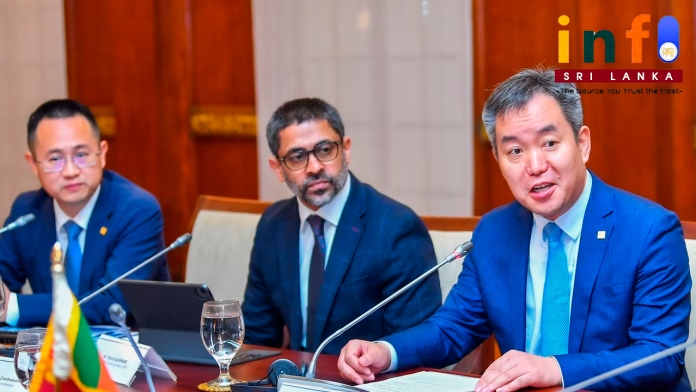
The US State Department has raised concerns about inconsistencies in Sri Lanka’s foreign investment policies, according to its 2025 Investment Climate Report for the island nation. The report highlights that senior officials within the National People’s Power (NPP) government frequently criticize private sector-led economic growth.
While the NPP government collaborates with the International Monetary Fund and provides assurances to investors, the report notes that many investors remain hesitant due to the government’s historical anti-Western and Marxist-influenced ideologies.
The American department further states that maintaining consistent and open dialogue with the Board of Investment of Sri Lanka, the primary investment promotion agency, has proven challenging.
Institutional Corruption Persists in Protected Sectors
Other issues hindering investment in Sri Lanka include excessive regulations, legal uncertainties, and a lack of responsiveness from officials.
The report also cites the withdrawal of Adani Green Energy, an Indian company, from a $400 million renewable energy project in Sri Lanka’s Northern Province. The reason provided by Adani was the Sri Lankan government’s attempts to renegotiate a previously awarded contract.
Despite the President’s public commitment to eradicating corruption and improving government transparency, and a noted decrease in high-level political bribery demands under the new administration, the report observes that institutional corruption continues, particularly in sectors protected by entrenched privileged groups.
A video of Minister Bimal Rathnayake laughing heartily, covering his head with his hands, at the mention of Minister Sunil Hadunnetti during a press conference at the Government Information Department today (30th) is currently circulating on social media.
Before the start of the press conference, Minister Bimal Rathnayake engaged in a friendly conversation with the journalists present. A brief exchange occurred between them:
Minister Bimal Rathnayake: “Journalists’ phones ringing is not a problem, is it? If ours rang…” Journalist: “Big question!” Minister Bimal Rathnayake, laughing with his hand on his head: “Ayyo, ayyo… I only recently found out how that came about.” Journalist: “There’s another one this week.” Minister Bimal Rathnayake: “Is that so? What is it?” Journalist: “The Nobel Prize.” Minister Bimal Rathnayake: “Ah, is that so…” Another journalist present: “Minister, what is that…?” Minister Bimal Rathnayake: “The Nobel Prize…”
He then answered and started the press conference, trying to hide his laughter.
Meanwhile, Minister of Industries Sunil Hadunnetti stated that his previous declaration regarding a record-breaking price for a kilogram of Sri Lankan tea at an auction in Japan was incorrect. He clarified that he mistakenly referred to it as a “Nobel Prize” instead of a “Guinness World Record,” emphasizing that it was not intentional. He made these remarks in a video released on his social media account.
However, the correction video also contained two minor errors: he referred to it as a “Jeans record” instead of a “Guinness record” and used “Nobel record” instead of “Nobel Prize.” The video was subsequently uploaded and removed within minutes.
Critics reacting to the incident suggest that the Minister has been ridiculed for his irresponsible behavior, acting without properly verifying crucial information regarding Ceylon Tea. They further highlight that an extraordinary price of JPY 125,000 (approximately USD 860) was fetched for a kilogram of New Vithanakanda FFExSp black tea at an auction held in conjunction with the World Expo Osaka in Japan, marking a highly significant milestone for Sri Lanka.
This exceptional achievement successfully drew global attention to the unique quality, heritage, and excellence of Ceylon Tea production. The New Vithanakanda Tea Factory had previously achieved a record price for its OP1 grade tea at the Colombo Tea Auction in 2023.
While this was an opportune moment to apply for a Guinness World Record, Minister Sunil Hadunnetti irresponsibly referred to it as a “Nobel Prize” recently received in Japan. It is important to note that Nobel Prizes are not awarded for tea sales records but for achievements in Physics, Chemistry, Medicine/Physiology, Literature, Peace, and Economics.
Setting a record as the world’s most expensive tea is a business and agricultural achievement, recognized by organizations like Guinness World Records, but it is not related to the scientific, literary, or socio-peace fields for which Nobel Prizes are awarded.
As the world confronts escalating climate disasters, the recent webinar “Beyond the Science: The Missing Piece in Climate Action – Communication” organized by the Climate Change Communication Hub in Sri Lanka brought together leading voices from South Asia to discuss why, despite robust science and decades of policy, the climate message continues to falter—and what must be done to fix it.
The panel featured Mr. Ranga Pallawala (Sri Lanka), a climate policy expert from the EU’s Switch-Asia Programme; Ms. Afia Salam (Pakistan), veteran journalist and environmental advocate; and Ms. Apoorva Pathak (India), doctoral researcher in international climate law. Moderated by Sharon Mascarenhas, the event delved deep into the communication chasm between climate knowledge and everyday action.
“Like a Car on a Cliff”: Ranga on the Urgency of Climate Action
Ranga Pallawala used a powerful analogy to drive home the stakes. “When you go to the peak without a break and start coming down, you cannot stop. It’s the same with climate change—once we cross certain thresholds, we lose control.” According to Ranga, the world is nearing that irreversible tipping point. “We are narrowing the space to act. If we don’t change direction now, we may not be able to reverse the consequences within this century.”
But Ranga emphasized that climate change is not just an environmental issue. “It affects every sector—health, economy, infrastructure, and education. Yet, our governance and institutions are structured for yesterday’s problems.” Alarmingly, he noted, “It’s even difficult to teach some doctors about climate change. That’s how disconnected the sectors are.”
Art Meets Science: Afia Calls for a Paradigm Shift
Afia Salam urged a shift in how we think and feel about the climate crisis. “Climate communication is both an art and a science,” she said. “It’s no longer about convincing people that climate change is real. The science is settled. What we need is relevance and resonance.”
She pointed out that climate change remains abstract to many because the messaging is often scientific and inaccessible. “We need to move from graphs and reports to storytelling. Use music, sports, religion, and art to connect with hearts, not just minds.” Quoting her experience with youth activism and local traditions, Afia argued for using street theatre, poetry, religious teachings, and oral storytelling as communication vehicles.
Why the Message Fails
So why does the climate message still fail to land? According to Ranga, one reason is its confrontational tone. “Often, we point fingers instead of inviting collaboration. We say the private sector is to blame, but forget that we’re part of the same market system.” He argued that communication strategies should focus on contribution over confrontation, building coalitions that include small businesses, farmers, architects, and households.
Afia echoed this, noting that climate activism must bridge silos. “The message fails when it’s abstract, jargon-heavy, or disconnected from lived experience. Communication needs to be tailored: what works for a glacial community won’t work for a coastal village.”
Apoorva added that for many in South Asia, daily survival takes precedence. “If people have food, water, and shelter, they don’t see why climate change matters—even though it impacts all those things.” She advocated for linking climate communication to immediate, relatable concerns: rising food prices, health risks, flood disruptions, and job loss.
The Missing Middle: Stakeholders Who Must Step Up
The panel agreed that key stakeholders are missing from the climate conversation—most notably the private sector. Ranga stressed that while public financing is crucial, it alone cannot solve the crisis. “Even if all developed countries give 25% of their GDP for climate finance, it’s not enough. We need private sector investment—from households to corporations—to shift markets and consumption patterns.”
He emphasized that changing the market system requires communicators to frame sustainability not as sacrifice, but as smart investment. “If you build a house, do it sustainably. If you’re a shop owner, stock green products. But people won’t act unless they see the value.”
Afia proposed another overlooked stakeholder: teachers. “Teachers are bridge builders between science and society. If we empower educators to integrate climate content creatively, it can reshape entire generations.”
Education, Youth, and Law: Apoorva on Building the Future
Apoorva highlighted that children and youth hold the key to long-term change. “Education from an early age must include climate change – not just in science, but in social studies, civics, even art.” She cited examples of student-led petitions and legal activism across the region, including a nine-year-old’s climate case in India and the global push for an International Court of Justice opinion on state obligations.
She also pointed to the courts as emerging climate actors. “In India, Sri Lanka, and beyond, courts are increasingly recognizing the right to a healthy environment. But this activism needs public support, which can only come through education and communication.”
Towards a New Playbook: What Next?
Ranga, borrowing again from the cricket metaphor that united the panel, said: “In an age of T20, we are still playing Test matches with climate communication.” He called for rapid, high-impact outreach using modern platforms and messengers – social media influencers, athletes, local heroes. “We need more ‘sector champions’ who speak climate in their own language. An aviation expert should talk about air turbulence. A chef should talk about food waste. That’s how we build a snowball effect.”
Afia added that the climate message must be seen through the lens of justice. “This is no longer just about climate change. It’s about climate injustice – where those least responsible are most affected. Until people see that, real action will lag.”
Conclusion: A Call to Action
The message from the webinar was clear: science alone will not save us. If we want to shift behavior, mobilize resources, and protect our shared future, we must rethink how we communicate climate change. This means crossing boundaries – between disciplines, sectors, and generations.
It’s time to move beyond the science and toward meaningful, inclusive, and actionable storytelling that empowers communities, influences policy, and turns awareness into impact.
As Ranga summed up, “There’s no tomorrow. We must act now – and we must speak to everyone, everywhere.”
The echoes of creativity and expertise continue to resonate following the Violin Art Appraisal Event held at the iconic Lotus Tower.
On August 18th, South Asia’s tallest tower transformed into a vibrant hub where passion met precision. The renowned Phoenix global expert team captivated attendees with their profound insights into the world of violins.
Participants were offered the unique opportunity to test premium-grade violins, experiencing firsthand the subtle nuances and rich tones that define true craftsmanship. The event also served as a valuable platform for Sri Lanka’s top violinists to connect, share their love for music, and forge invaluable networks.
This gathering was more than just an appraisal; it was a celebration of artistry, a testament to dedication, and a powerful harmony of talent and tradition. The organizers extended their gratitude to everyone who attended, making the event an unforgettable success, and expressed anticipation for their next inspiring gathering.
Bengaluru: In a significant public disclosure, Indian Air Force (IAF) chief AP Singh has confirmed that “Operation Sindoor” destroyed five Pakistani fighter jets and one intelligence aircraft. Speaking at the Air Chief Marshal LM Katre lecture in Bengaluru, Singh provided the first official details of the extent of damage inflicted on Pakistan’s military assets following the Pahalgam terror attack.
According to the IAF chief, the Indian armed forces’ surface-to-air missile systems, including the Russian-made S-400 Triumf, played a crucial role in the operation. “We have at least five confirmed kills and one large aircraft… This is the largest ever recorded surface-to-air kill that we can talk about,” he stated.
Damage to Pakistani Airbases and Assets
Singh further revealed that India’s strikes on Pakistani military sites on May 10 also caused severe damage to key airbases. At the Jacobabad airfield, which houses F-16 fighter jets, “one half of the hangar is gone,” with some parked F-16s also sustaining damage.
Additionally, two command and control centers—Murid and Chaklala—were damaged, along with at least six radars. The IAF chief indicated that at least one AEW&C (Airborne Warning and Control System) aircraft and several F-16s that were under maintenance were also affected.
The strategic pounding of these airbases, some of which were not yet operational, reportedly led Pakistan to call for a ceasefire after three days of hostilities. Singh credited the S-400 system for its “game-changer” capabilities, which kept Pakistani aircraft from using their long-range glide bombs by preventing them from penetrating India’s air defense perimeter.
No Collateral Damage or Political Hurdles
Singh also addressed claims of civilian casualties, stating that satellite images of the nine terror targets attacked on May 7 show “no collateral damage,” directly rebutting Pakistan’s accusations. He confirmed that around 100 terrorists were killed in the strikes on terror launchpads.
Regarding accusations of operational restrictions, the Air Chief firmly rejected the opposition’s charges, asserting that the military was given complete freedom to plan and execute the attacks. “A key reason for success was the presence of political will. We were given very clear directions. No restrictions were put on us,” he said. Singh added that any constraints were self-imposed and that the attacks were “calibrated because we wanted to be mature about it.” This statement also appears to counter remarks made by an Indian defense attaché that were cited by Congress MP Rahul Gandhi, which the Indian embassy later clarified as “taken out of context.”
Colombo: The Valana Anti-Corruption Strike Force has seized machinery worth millions of rupees belonging to a local company that was illegally mining ilmenite in a highly sensitive, archaeologically valuable area adjacent to the Puttalam Cement Factory.
The area is a land with fossil evidence from the Miocene era, over 23 million years old, and spans 4,000 acres of forest land. It is considered a highly sensitive zone because its rock deposits reveal ancient geological evidence.
Influence of Chamara Sampath
The raid revealed that the company lacked the necessary legal permits and qualifications for mining. Reports indicate that permission to start this project was granted under the direct influence of Mr. Chamara Sampath Dissanayake, the State Minister in charge of the subject in the previous government.
Furthermore, it is stated that the then Secretary to the Ministry of Industry and the Treasury representative of the Cement Corporation opposed this fraudulent agreement. A letter sent by J. S. Dharmapriya, then Chairman of the Cement Corporation, to the Chairman of Siam City Lanka Cement Company regarding this project, states: “Minister Chamara Sampath Dissanayake frequently reminds me about this, and he would be very happy if the project is expedited.”
Further investigations into this incident are ongoing, and charges may be filed for damaging archaeologically valuable land and abuse of power.
COLOMBO: A number of opposition-controlled, low-income local government bodies are facing a severe crisis in paying employee salaries due to the government’s decision to cease employee salary reimbursements.
According to Samagi Jana Balawegaya (SJB) National Organizer Tissa Attanayake, the primary reason for this situation is the government’s notification that it will no longer provide the 20% salary reimbursement. He emphasized that while previous governments have consistently reimbursed these funds for salary payments, these funds have not been received this time.
Salary Payment System by Council Type: Municipal Councils: The government provides 60% of employee salaries, with the remaining 40% to be paid from the council’s income. Divisional Councils: The government provides 80% of employee salaries, with the remaining 20% to be paid from the council’s income.
Attanayake stated that this issue affects approximately 25% of the low-income councils controlled by the opposition. While high-income municipal councils are not significantly impacted, several low-income, remote divisional councils are severely affected. He specifically mentioned that the Laggal, Pallepola, and two Ambaganga Korale divisional councils are facing acute distress due to this problem.
It is reported that this situation could lead to delays in salary payments for employees of the affected local government bodies, potentially disrupting their daily activities.
ANURADHAPURA – A bomb scare gripped Anuradhapura today after an emergency call reported a suspicious device near a hotel frequently used by the President during his visits to the area. Police confirmed the discovery of an explosive device resembling a hand grenade outside a house near the Premier Inn hotel in Perimiyankulama, Anuradhapura.
However, investigations later revealed the device was not a conventional hand grenade but a “hakkapatas,” a type of explosive used for hunting animals, disguised as a ball of thread.
Anuradhapura Headquarters Police stated that three young men found in the house were arrested on suspicion in connection with the incident. Police added that two of the arrested individuals were outsiders. Further investigations are underway to determine if they are involved in any criminal activities.
Following the urgent telephone call to the police, Senior Superintendent of Police Thilina Hewapathirana, who is in charge of the Anuradhapura division, along with other senior officers, arrived at the scene.
COLOMBO: Reports indicate that Waruna Rajapaksha, the Samagi Jana Balawegaya (SJB) Gampaha electorate organizer, is set to participate in a program in Galle organized by ‘Dinana Dakuna’ (Winning South).
This organization has faced accusations on social media of being affiliated with the United National Party (UNP) and acting as a proxy for Ranil Wickremesinghe. Interestingly, Waruna Rajapaksha himself has previously leveled strong criticisms against the organization on several occasions.
Political analysts are now questioning whether Rajapaksha’s association with ‘Dinana Dakuna’ signals his potential departure from the Samagi Jana Balawegaya.
Waruna Rajapaksha contested the last general election representing the Gampaha district for the Samagi Jana Balawegaya and is known to be a close associate of Sajith Premadasa.
However, it is also noted that until the final stages of the last presidential election, Waruna Rajapaksha worked in the media division of former President Ranil Wickremesinghe and contested the 2020 parliamentary election representing the United National Party.
Before this, Waruna Rajapaksha was a key founding member of the First Front and the Frontline Socialist Party, and even earlier, he served as a member of the political bureau of the Janatha Vimukthi Peramuna.
Having entered politics at a young age, Waruna is well-known as a powerful communicator and a political and global analyst.
A previous statement by Waruna Rajapaksha, emphasizing that all divided forces must unite into one camp to strengthen the Southern Province, also garnered significant attention in political circles.
COLOMBO: Presidential, Prime Ministerial, and Speaker’s Offices, along with the Parliament and other government institutions, are reportedly failing to properly provide information in response to requests made by citizens under the Right to Information (RTI) Act.
A local weekend newspaper highlights this issue, stating that information requests sent by a correspondent to the Presidential Secretariat, Prime Minister’s Office, Speaker’s Office, and Parliament in July have so far received no response from any of these three institutions.
Among the withheld information are details concerning the President’s staff, private advisors, the Clean Sri Lanka project, and a report on 329 containers. Similarly, information regarding the Prime Minister’s staff and vehicle auctions has also not been provided.
A request for information on the Speaker’s staff was denied, citing parliamentary privileges. However, it is noteworthy that a previous Court of Appeal ruling (CA/RTI/0004/2021) on RTI matters affirmed that Members of Parliament are not a special group and must operate under the country’s law, as public representatives appointed by the people and accountable to them.
Furthermore, the functioning of the Right to Information Commission has been hampered due to incomplete membership. Although the Constitutional Council reportedly approved a nominee for a vacant commissioner position and forwarded the name to the President over two weeks ago, the President has yet to make the appointment.
Experts in the field and legal scholars point out that three of the current commissioners are lawyers, and the President has the authority to appoint one of them as the Chairman of the Commission.
With the position of Chairman of the RTI Commission vacant for over six months, the Young Journalists’ Forum and the Diyatasa Sanvidanaya filed a fundamental rights case in the Supreme Court on the 29th, alleging that the President’s failure to make this appointment violates the fundamental rights of the people.
Additionally, journalist R.B.J. Suranga and others filed a complaint with the Human Rights Commission last week (HRC/HO/2228/25), stating that the RTI Commission is delaying decisions, citing the lack of a chairman as a reason.
In response to these concerns, several media organizations have sent a letter to the President, urging him to take action to strengthen the Right to Information and to expedite the pending appointments to the Right to Information Commission.